Frau Diller
The Book ThiefFrau Diller, known as the Aryan shopkeeper, runs the corner shop at the end of Himmel Street. Her decisive significance lies in the way she makes ideology material: the Third Reich appears in her shop’s cold atmosphere, in the framed photograph of Hitler, in the compulsory greeting demanded of customers, and in the money she directs toward the Nazi Party. Yet her encounters with Liesel Meminger and Rudy Steiner also place that public severity beside the children’s hunger, resourcefulness, and growing resistance to the meanings imposed on them.
Identity and Shop
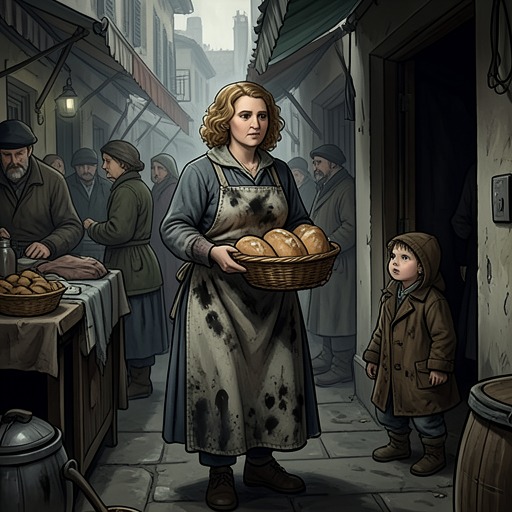
Frau Diller is presented as a sharp-edged woman with fat glasses, a nefarious glare, soldierlike posture, a refrigerated voice, and breath that smells of “heil Hitler.” Her shop is white, cold, and “completely bloodless,” while the small house pressed beside it seems to shiver more severely than the other buildings on Himmel Street. The atmosphere is not incidental decoration: Frau Diller administers the shop’s hostility, making intimidation the only free item available from her premises.
Her one golden rule governs entry into the space. Anyone who walks into the shop without saying “heil Hitler” will not be served. The requirement turns a routine purchase into a political demonstration. Behind her usual sitting position hangs a framed photograph of Hitler, while the Führer’s image also appears in the bulletproof eyes that leer from the shop window. The shop therefore operates as both a commercial establishment and a miniature ceremonial outpost of Nazi Germany, demanding submission before it permits access to goods.
Politics and Wartime Commerce
Frau Diller’s loyalty is practical as well as theatrical. Even when rationing later begins, she is known to sell certain difficult-to-obtain items under the counter and to donate the money to the Nazi Party. Scarcity does not weaken her attachment to the regime; it gives that attachment another channel through which to operate. The shop’s hidden transactions and political donations connect ordinary economic exchange with organized power, showing how ideology can survive not only in speeches and uniforms but also in the management of food and supplies.
Her public persona also belongs to a wider system of racial and national classification. Liesel Meminger arrives with dark brown eyes in a Germany where such eyes are considered dangerous, while the narrative links Liesel’s father to the unexplained label “Kommunist.” Elsewhere, Alex Steiner is identified as a Nazi Party member who does not hate Jews, and Max Vandenburg’s history with Walter Kugler is later cut across by the Nuremberg Laws, which forbid Jews German citizenship and prohibit marriage between Germans and Jews. Against this background, Frau Diller’s insistence on the prescribed greeting is more than personal unpleasantness: it is a small, daily enforcement of the symbolic boundaries through which the regime defines belonging.
Encounters with Liesel and Rudy
Frau Diller becomes part of Liesel Meminger and Rudy Steiner’s education in hunger, theft, and social power. The children are driven toward stealing by depressing pea soup and Rudy’s hunger. After watching older children steal fruit from farmers, they learn to keep their eyes open and begin to recognize opportunities that respectable society has left unequally distributed. Their first attraction is not abstract rebellion but the sight of magnificent Klar apples bulging from Fritz Hammer’s pockets.
Their later encounter with Frau Diller gives this developing practice a different texture. Liesel stands outside the whitewashed wall with a piece of candy in her mouth, and the shopkeeper’s presence becomes part of the children’s improvised economy of food, risk, and revenge. On another afternoon, after collecting sixteen coins by selling chestnuts, Liesel and Rudy return to the shop, perform the required “heil Hitler” greeting, and wait. When Frau Diller offers mixed candy again, they place their money on the counter and ask for it together. The ritual that was meant to display obedience is repeated by the children as a controlled performance, allowing them to turn the shopkeeper’s rule into part of their own small strategy.
Rudy later rejects Frau Diller’s understanding of theft. He tells Liesel that she is not really a thief because the woman lets her in and even leaves her cookies; for him, true stealing is what the army does when it takes his father and Liesel’s father. He distinguishes the children’s acts from the state’s seizure of people, while naming the wealthy Nazis on Grande Strasse, Gelb Strasse, and Heide Strasse as beneficiaries of that larger theft. Frau Diller’s shop thus becomes a measuring point in the book’s moral contrast between petty hunger-driven stealing and organized political violence.
Destruction and Narrative Significance
Frau Diller’s fate is revealed in the aftermath of the bombing of Himmel Street. Unlike the sleeping members of the Fiedler household and the Steiner family, whose bodies remain covered and recognizable in their homes, Frau Diller is found fast asleep with her bulletproof glasses shattered beside the bed. Her shop has been obliterated: the counter has landed across the road, and the framed photograph of Hitler has been torn from the wall and thrown onto the floor. The narrator’s bitterly comic image of Hitler being metaphorically beaten into glass-shattering pulp converts the former emblem of authority into wreckage.
The destruction reverses the shop’s earlier arrangement of power. Frau Diller once controlled the threshold, deciding who would be served and requiring a salute to the regime; after the bombing, the shop itself has lost its walls, counter, and political icon. Her death does not redeem her or erase her allegiance, but it demonstrates the collapse of the world that gave her severity its authority. The contrast with the dead on Himmel Street is also telling: the shopkeeper’s rigid public symbols are broken, while the human consequences of the regime remain the central measure of the catastrophe.
Frau Diller is therefore a minor character with a concentrated symbolic function. She embodies the ordinary mechanism by which Nazism enters daily life, making a greeting, a purchase, a framed picture, and a shop window participate in ideological discipline. Her encounters with Liesel Meminger expose how children can mimic, manipulate, and morally reinterpret such rituals, while her final appearance among the ruins reveals the instability beneath the shop’s supposed bulletproof certainty.